
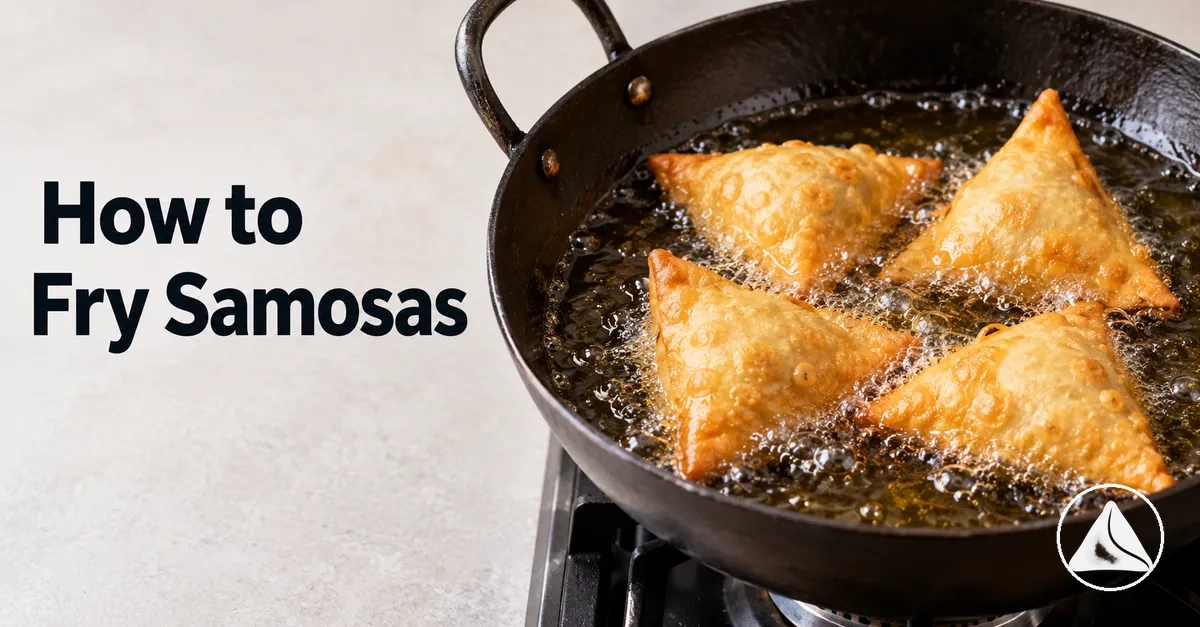
How to Fry Samosas
To fry prepared samosas, start with dry, securely sealed pastries in an uncrowded batch and fry gently until the pastry shell firms. Increase the heat gradually if needed, turning until the pastry becomes evenly golden and crisp. Check the filling’s cooking requirements separately—colour, bubbling and elapsed time alone cannot confirm internal doneness—then lift out and drain in a single layer.
Frying at a glance
What you see → what to do next
Match the condition of the samosas to the next action. This is a practical guide to the frying sequence, not a fixed temperature or timer.
-
Before adding a batch
Check Dry, closed seams; oil deep enough to surround the pastries; headroom in the pan.
Next action Add a small batch to suitable, non-smoking oil with space to turn each samosa.
-
Pale, soft pastry
Check Steady bubbling with no rapid darkening; the outer shell is not yet firm.
Next action Continue gently, keeping the samosas separated while the shell sets.
-
Shell firm; colour developing
Check Each samosa holds its shape and the surface is beginning to brown.
Next action Turn as needed and gradually increase the heat only if controlled browning requires it.
-
Evenly golden, firm shell
Check Crisp exterior and folds, plus the filling’s separate cooking requirements.
Next action Lift out, let surface oil drip off, and drain the samosas in a single layer.
If the shell darkens too fast: lower the heat and turn the samosas rather than rushing the finish. A golden exterior cannot confirm that a filling which requires cooking is safe to eat.
Batch size, pastry thickness, oil recovery and starting conditions affect how quickly the shell firms and browns. For commercially frozen or precooked samosas, follow the product's frying instructions rather than assuming that the fresh-pastry method or timing is identical.
Table of Contents
Prepare the Samosas and Oil for Frying
Before frying, have the prepared samosas, frying oil, vessel, and batch space ready for immersion.
The number of samosas that can be fried together depends on their size and the vessel's usable capacity.
The setup illustrated here shows sealed samosas beside a deep pan, with visible space above the oil and an uncrowded working area.
This immediate readiness check is separate from the broader samosa-making process.
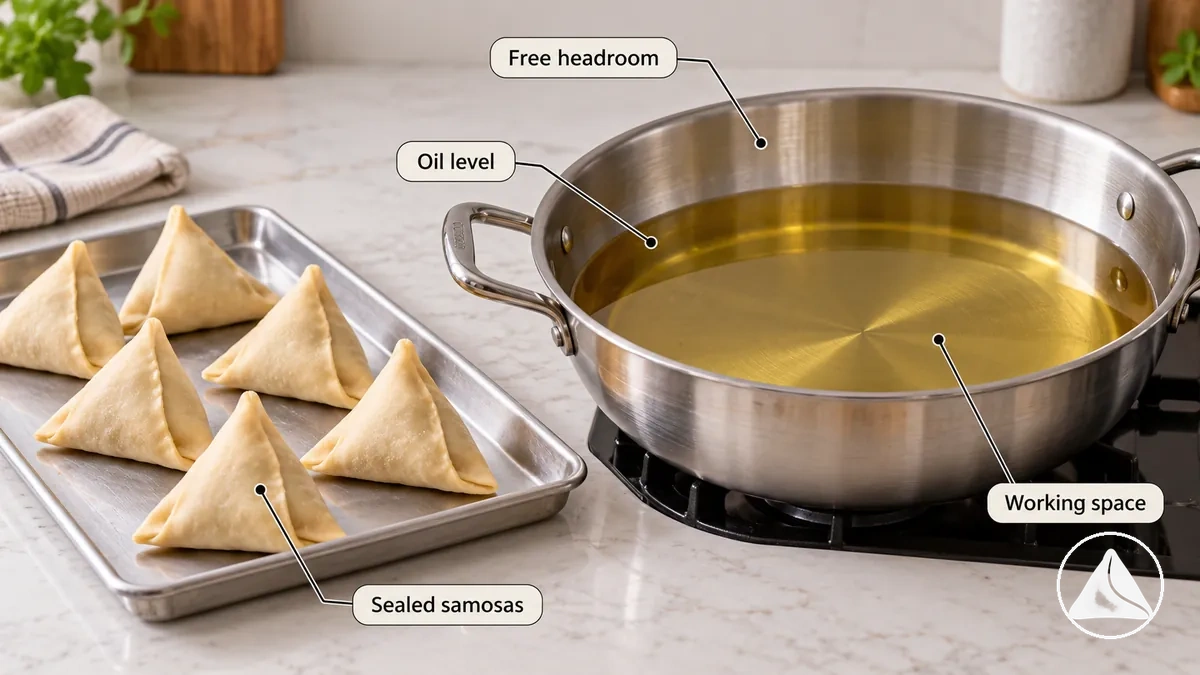
Verify samosa readiness and oil-and-vessel readiness using these checks before lowering the first batch into the oil:
- Samosa readiness — secure closure: Check that each samosa is sealed along its seams and that no filling is exposed.
- Samosa readiness — dry exterior: Check that the pastry surface is dry, without visible water droplets or wet patches before the samosas touch the oil.
- Oil-and-vessel readiness — frying oil: Confirm that the selected oil is suitable for deep frying, is free from visible contamination, and is not smoking before adding the samosas.
- Oil-and-vessel readiness — headroom: Check that the vessel has sufficient free space above the oil to accommodate the rising oil level and bubbling when samosas are added.
- Oil-and-vessel readiness — batch spacing: Choose a batch small enough for the samosas to remain separated and be turned without crowding. Reduce the batch size if the available vessel space cannot accommodate them.
Choose an Oil Suitable for Deep Frying
Choose frying oil for samosas based on its heat stability, smoke point, and flavour rather than brand or popularity.
According to the Michelin Guide, smoke point is the temperature at which oil begins to smoke, but it is not a complete measure of oil stability during prolonged heating.
A neutral refined oil, such as refined sunflower or canola oil, lets the filling’s seasoning remain prominent. A strongly flavoured oil, such as cooking-suitable mustard oil, contributes a more distinctive taste when that flavour is intended and the oil is suitable for deep frying.
The accompanying image shows clean frying oil in a deep vessel with samosas nearby, illustrating the frying setup rather than endorsing a particular oil or brand.
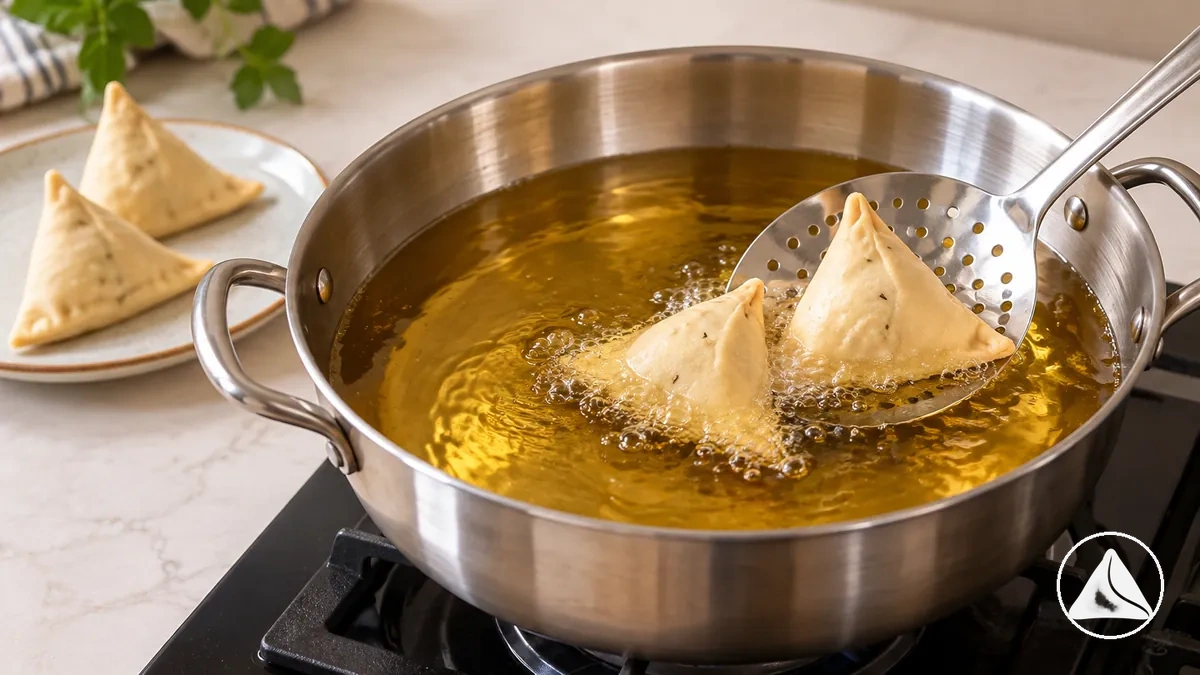
Evaluate frying oil using these functional criteria, which connect its heating behaviour, flavour contribution, and condition to suitability for cooking samosas:
- Heat stability: Select an oil intended for sustained high-temperature cooking. An oil that resists deterioration under the intended frying conditions is more suitable than one that develops burnt odours or degrades rapidly during heating.
- Smoke point: Choose an oil whose smoke point is above the intended frying temperature. If the oil begins smoking during normal frying, its temperature or condition needs reassessment rather than continued use at the same heat.
- Flavour contribution: Use a neutral-flavoured refined oil when the samosa pastry and filling should determine the dominant taste. Choose a more strongly flavoured oil only when its flavour is intentional and the oil is suitable for the cooking conditions.
- Repeated-heating suitability: Assess the oil's condition between batches, particularly after prolonged or repeated heating. The USDA Food Safety and Inspection Service advises discarding used frying oil when it becomes cloudy, starts foaming, or develops a foul odour; excessive darkening or smoking also indicates deterioration.
Set the Oil Depth for Full, Even Frying
Set the oil depth so the samosas are surrounded by frying oil while the vessel retains sufficient headroom above the oil.
The accompanying cross-sectional illustration shows how oil surrounds the samosas while leaving space within the vessel, clarifying the spatial relationship without prescribing a universal depth.
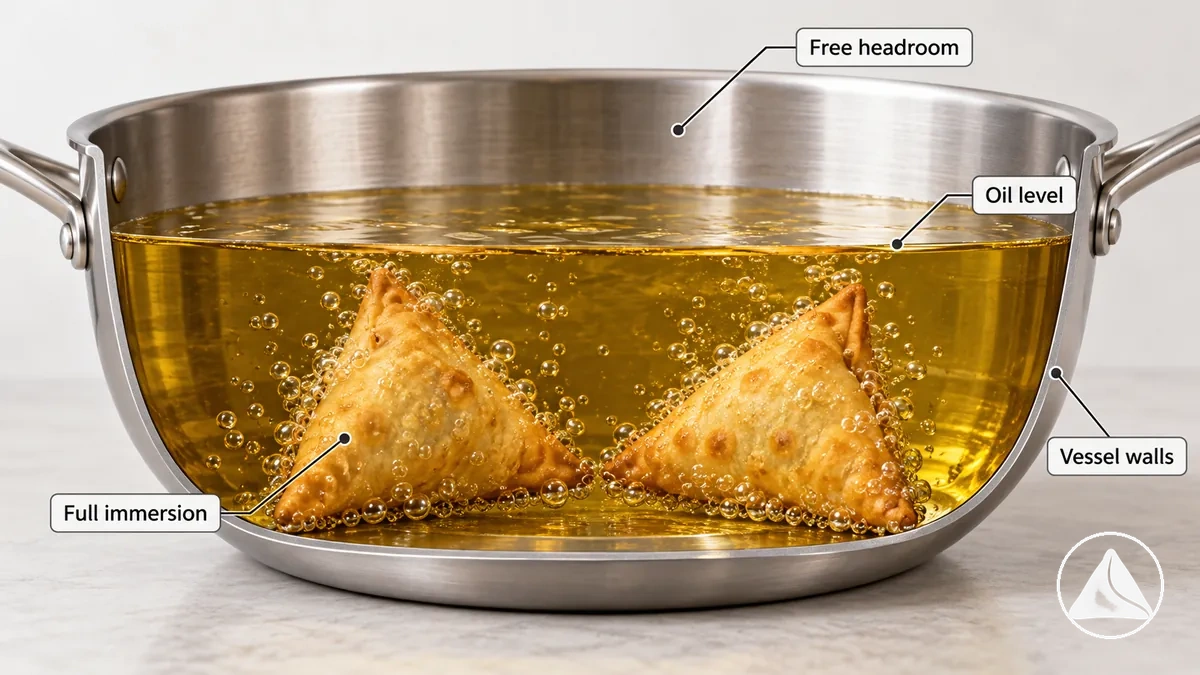
- Immersion
- The oil must cover each samosa when fully submerged. If it cannot, use a more suitable vessel or reduce the batch rather than overfilling the pan.
- Headroom
- Allow free space below the rim for displaced oil and bubbling. The oil level rises as the samosas enter it.
- Pan shape
- A wider vessel requires more oil to reach the same depth; a shallow vessel may lack room for both immersion and safe headroom.
- Batch space
- Keep enough room to separate and turn the samosas. Reduce the batch size whenever pieces crowd each other.
Sufficient immersion supports heat transfer around the pastry and more even frying, but oil depth alone does not determine browning; controlled heat and manageable batch size remain necessary.
Fry Samosas in Controlled Stages
Fry samosas in controlled stages, using changes in the pastry shell rather than a fixed cooking time to decide when to adjust the heat and finish frying.
The accompanying image shows the progression from a gentle fry to a firm shell and then a golden finish, helping you recognise each stage before moving to the next.
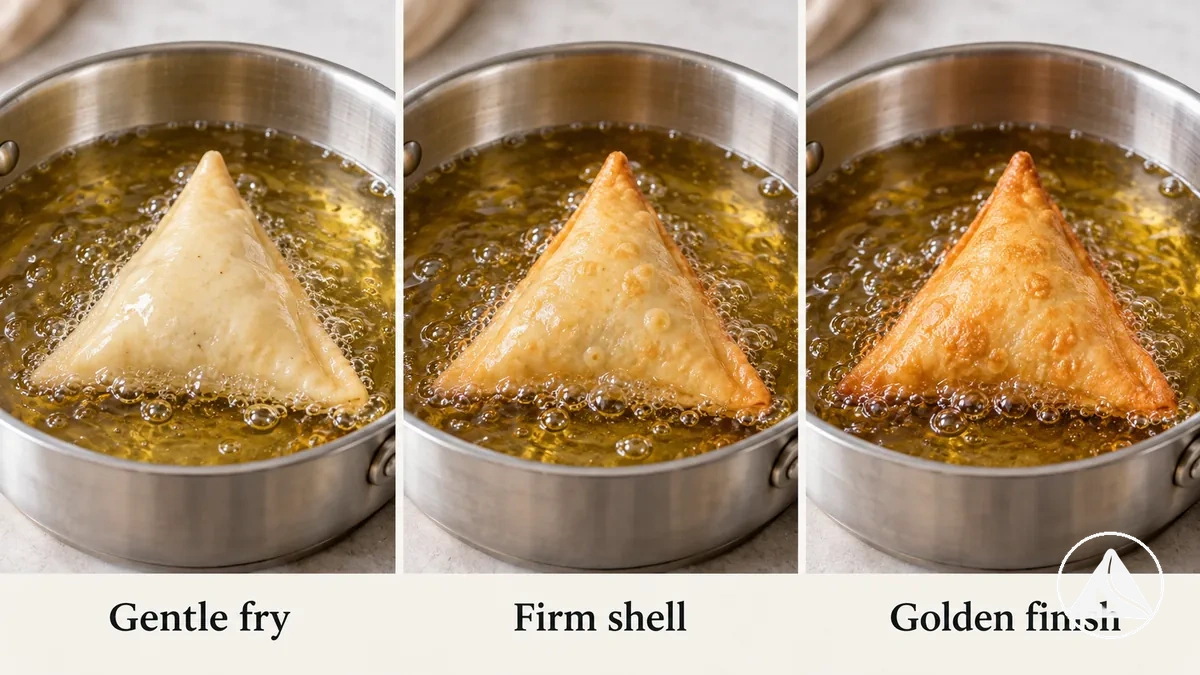
- Begin with a manageable batch: Carefully lower the samosas into the oil, leaving enough spacing for oil circulation and turning. If adding the batch noticeably reduces bubbling, allow the oil to recover before adding more samosas.
- Maintain a gentle fry: Keep the heat controlled while the pastry shell is still soft. Look for steady bubbling and the outer surface beginning to firm without browning rapidly.
- Turn the samosas as the shell firms: Once the pastry holds its shape, gently turn or reposition the samosas to expose different sides to the oil. Maintain enough space between them for even frying.
- Increase frying intensity after the shell firms: Gradually increase the heat as needed when the pastry becomes firm and its colour begins to develop. Continue turning when necessary, checking that the samosas become golden without darkening too quickly.
- Verify the finish and remove: Check that the samosas have an evenly golden, firm exterior before lifting them from the oil. Allow excess oil to drip away as they are removed.
If samosas begin opening or bursting during frying, treat this as a separate troubleshooting issue rather than a normal stage of the frying sequence.
Begin with a Slow Fry for Even Cooking
Begin the slow fry with gentle heat so the samosas' pastry can cook progressively and the outer shell can firm before rapid browning.
The required heat setting depends on the vessel, oil condition, and batch size rather than one universal temperature.
The accompanying image shows samosas frying with moderate bubbling and intact, lightly coloured shells, illustrating the initial stage rather than a specific temperature setting.
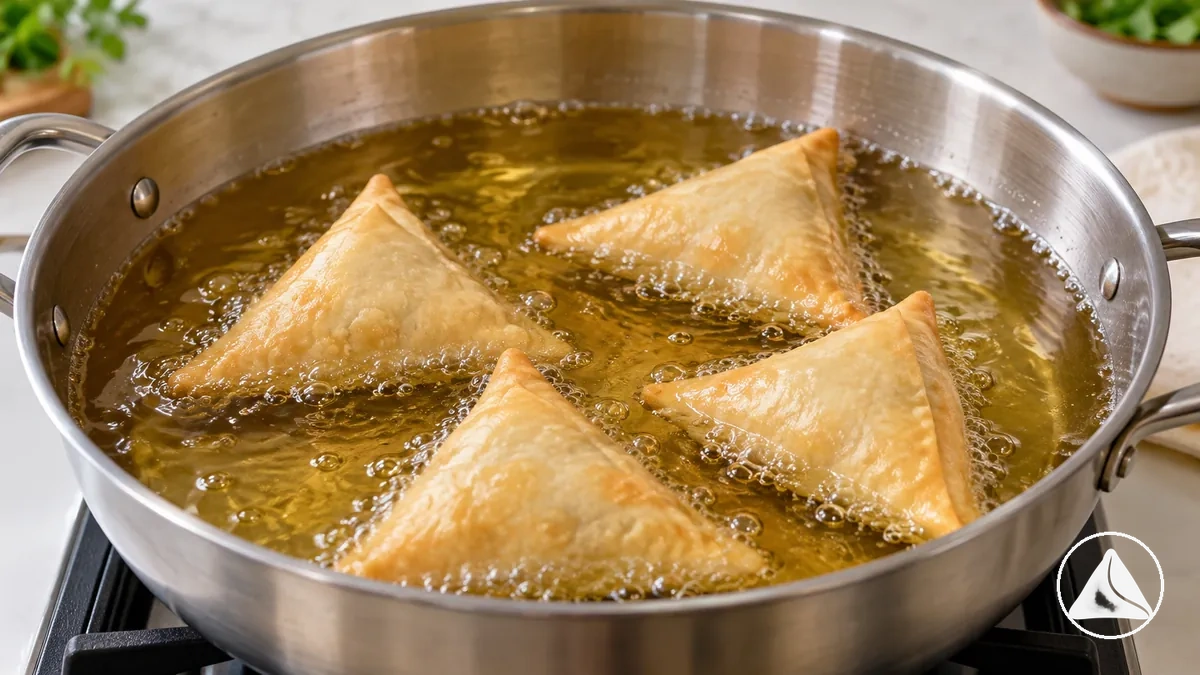
When to stay gentle—and when to move on
Keep frying gently
If: the pastry is still soft and pale to light golden, even if steady bubbles are visible.
Do: keep the batch spaced apart and avoid rapid surface browning as the shell firms.
Begin the finishing stage
When: the shell visibly firms and each samosa holds its shape.
Do: adjust heat gradually if browning needs to progress. Bubbling alone does not prove the shell has set.
Increase the Heat After the Pastry Firms, Then Fry Until Golden
Once the samosas have a firm shell that holds its shape, increase heat gradually so the pastry can complete its browning and crisping without scorching.
The heat increase should produce progressive browning rather than rapidly darkening the exterior.
The accompanying image illustrates the finishing transition from a pale, set shell to an evenly golden surface.
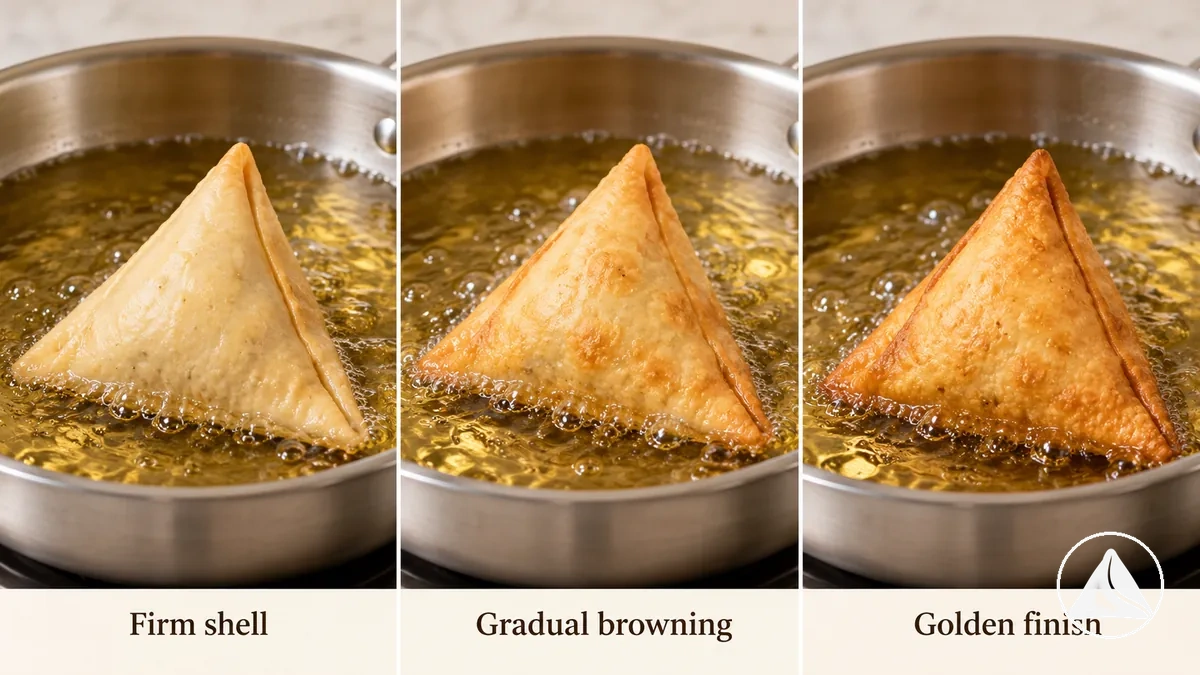
Adjust according to the browning pattern
- Colour develops evenly
- Continue turning or repositioning the samosas so every side colours at a controlled rate.
- Dark patches appear rapidly
- Reduce the heat and keep turning; do not increase the frying intensity while the exterior is darkening too quickly.
- Some samosas colour sooner
- Monitor those pieces individually and adjust their positions to maintain a more even finish across the batch.
Once the exterior approaches an even golden colour, avoid further overbrowning and verify doneness separately before removal, because colour alone does not confirm that the samosas are fully cooked.
Remove and Drain Samosas After Frying
Once the frying finish point is confirmed, remove the fried samosas promptly, allow excess surface oil to drain, and keep the pieces spaced apart so steam can escape.
The following actions control surface oil and steam immediately after frying, helping maintain the pastry's crisp texture without trapping moisture around the samosas.
- Lift and drain briefly: Use a slotted spoon or frying spider to lift the finished samosas from the oil. Hold them briefly above the frying vessel to let excess surface oil drip back into the pan.
- Place on a draining surface: Transfer the samosas to a wire rack positioned over a tray or an absorbent paper-lined surface. A rack allows oil to drip away, while absorbent paper collects oil that comes into contact with it.
- Keep the samosas spaced apart: Arrange the pieces in a single layer with gaps between them rather than stacking them. This spacing allows steam to escape instead of becoming trapped between the hot pastry surfaces.
Use Frying Time Together with Doneness Signals
Frying time is a checking window, not a stop signal. Use elapsed time alongside the pastry’s colour, firmness and bubbling rather than deciding from minutes alone.
Samosa size, pastry thickness, batch load, starting oil condition, and oil recovery can all change the cooking duration.
For medium-size, freshly assembled samosas with uncooked pastry and precooked filling, roughly 10–20 minutes can serve as a broad window for checking progress during a gradual fry—not a guaranteed finish time. Smaller or thinner pieces may finish sooner; thick or cold pieces may need longer. Use package directions for frozen or commercially prepared samosas.
Use elapsed time to guide when to check the samosas, but assess colour, texture, and bubbling together before deciding whether frying is complete.
Why Frying Time Varies by Samosa Size and Frying Conditions
Frying duration varies because samosa size and pastry thickness affect how far heat must penetrate, while batch conditions influence how consistently the oil transfers heat to the food.
Even samosas prepared from the same recipe may require different cooking times when the batch load, vessel capacity, or starting conditions change.
These differences explain why cooking duration cannot be predicted reliably from samosa type alone.
The following conditions explain how physical differences and oil behaviour can shorten or extend frying duration.
Each directional effect assumes other frying conditions remain reasonably comparable, rather than representing a fixed adjustment in minutes.
- Samosa size: Larger samosas generally require more time than smaller ones because heat must travel farther through the pastry and filling before the centre is heated.
- Pastry thickness: Thicker pastry can take longer to cook and develop a firm shell, while thinner pastry may reach the same surface state sooner under comparable frying conditions.
- Batch load: Adding more samosas at once can cause a greater drop in oil temperature, potentially slowing cooking and extending the frying duration if the oil does not recover promptly.
- Oil recovery: When oil takes longer to return to a steady frying condition after the samosas are added, cooking may progress more slowly. Faster recovery helps maintain a more consistent frying rate.
- Vessel capacity: A smaller vessel holding relatively little oil for the batch may experience greater temperature fluctuations, potentially lengthening cooking time. A suitably sized vessel with adequate oil capacity can support more stable frying conditions, although vessel size alone does not determine duration.
- Starting conditions: Cooler starting oil or colder samosas may increase the time needed for cooking to progress. Hotter starting oil may brown the exterior sooner, but faster browning does not necessarily mean the pastry and filling have finished cooking.
Judge Doneness by Colour, Texture, and Bubbling
Judge samosa doneness by combining golden colour, a firm shell, crisp texture, an even surface, and changes in bubbling rather than relying on any single cue.
These observable signals help assess whether the pastry is ready to leave the oil, but none independently proves complete cooking.
Use the following verification checklist to interpret each signal alongside the others before removing the samosas.
- Golden colour: Check whether the pastry has developed an even golden colour across its visible sides. Consistent browning supports the judgment that the exterior has finished frying, but colour alone does not establish internal doneness.
- Firm shell and crisp texture: Gently assess the pastry with a suitable frying utensil. A shell that holds its shape and feels firm rather than soft or flexible suggests that the outer pastry has set and developed a crisp texture.
- Even surface: Inspect the folds, edges, and exposed sides for consistent browning and surface firmness. Pale, soft areas may indicate that parts of the pastry need further cooking, even when other areas appear golden.
- Bubbling behaviour: Observe whether bubbling has become calmer compared with the earlier frying stage. Reduced bubbling may support a doneness judgment as moisture release changes, but the frying response also depends on oil conditions and cannot independently confirm readiness.
Single Frying vs Double Frying: How the Process Changes
Single frying cooks samosas through one continuous frying cycle, while double frying divides the process into two separate frying cycles with an intermediate rest outside the oil.
In single frying, the heat may be adjusted during the same cycle to develop the required colour and texture.
Double frying adds a second opportunity for browning and crisping, but an additional frying cycle does not automatically produce a better result.
The appropriate method depends on the intended preparation and serving conditions rather than a universal advantage.
| Criterion | Single frying | Double frying | Practical implication |
|---|---|---|---|
| Frying cycles | Uses one continuous frying cycle to cook the samosas and develop the finished exterior. | Uses an initial frying cycle followed by a separate second fry. | Double frying creates a distinct finishing stage, while single frying completes the process without removing the samosas between cycles. |
| Intermediate rest | Requires no intermediate rest between frying cycles. | Includes a period outside the oil between the first and second cycles, often allowing the pastry to drain and cool to some extent. | The extra interval changes the sequence and requires appropriate handling before frying resumes. |
| Handling and time commitment | Requires one placement into the oil and one final removal, with no separate frying stage to schedule. | Requires removing the samosas after the first cycle, handling them during the rest, and returning them to the oil. | Double frying generally involves more handling and a longer overall process, although the difference depends on the rest and frying conditions. |
| Texture objective | Aims to develop a firm, golden pastry shell within one frying cycle. | Uses the second cycle as an opportunity to develop additional surface browning and crisping. | A second fry may improve surface texture under suitable conditions, but excessive frying can cause overbrowning or an overly hard shell. |
| Serving and preparation context | May suit samosas intended for serving shortly after frying, where a continuous process is convenient. | May suit a workflow that separates initial cooking from a later finishing fry, provided the samosas can be held safely between cycles. | Advance preparation requires suitable food-safe holding conditions, particularly when fillings contain perishable ingredients; separating cycles does not itself establish safe storage or complete cooking. |