
How to Store Cooked Samosas
To store cooked samosas, let excess steam escape briefly, then refrigerate in a clean, covered container below 5°C within 2 hours and eat within 3 days. If they have spent 2 to under 4 cumulative hours between 5°C and 60°C, eat them immediately instead of storing them; at 4 hours or more, discard them.
STORAGE DECISION GUIDE
What should you do with cooked samosas now?
Add up all the time the samosas have spent between 5°C and 60°C, including separate periods of cooling, serving and transport. The total determines whether they can be stored for later.
-
Under 2 hoursStorage still possibleEat now or store promptly
Let excess steam escape briefly. Refrigerate in a clean, shallow, covered container below 5°C and eat within 3 days. Freeze promptly at −18°C or colder for longer storage.
-
2 to under 4 hoursDo not store for laterEat immediately
Use the samosas now; do not return them to the fridge or freezer for later use.
-
4 hours or moreOutside safe holding timeDiscard the samosas
Do not keep, reheat or freeze them to try to recover food that has exceeded the time limit.
Important: These time bands concern cooked samosas requiring temperature control. If their holding history is uncertain, do not assume that smell, appearance or crispness proves safety. Cooling should be brief, not an extended stay on the bench.
Keeping samosas safe and keeping their pastry crisp are different tasks: time and temperature govern storage safety, while trapped steam and condensation mainly affect texture.
Table of Contents
Cool Samosas Before Storing Them
Freshly cooked samosas should release residual heat and steam before they are sealed for storage.
Closing them while they are still warm can trap vapour, allowing condensation to add moisture to the pastry instead of letting that moisture escape during cooling.
Let heavy steam subside briefly before packing the samosas. Do not leave them out until fully cold if that would delay refrigeration beyond the two-hour limit; small, shallow portions cool faster.
The visual below shows the spacing and open cooling setup that allows heat and steam to escape before containment.
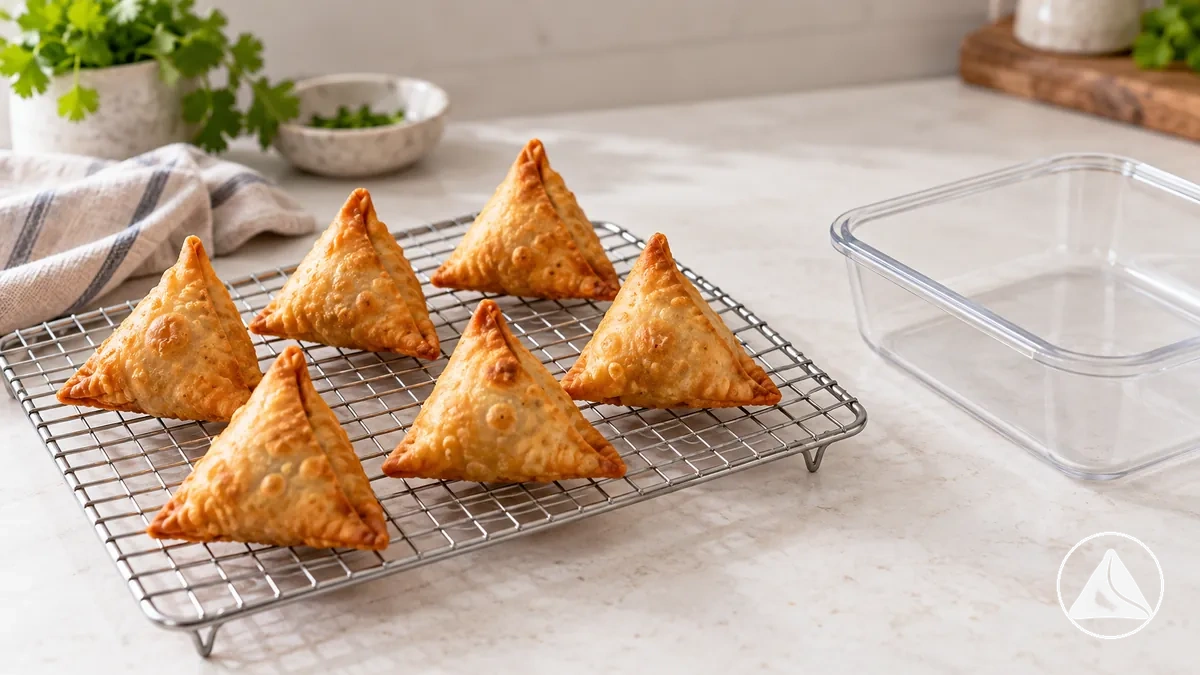
- Spread the freshly cooked samosas in a single layer on an open rack or plate, leaving space between them so heat and steam can escape.
- Allow the residual heat to dissipate without sealing or tightly covering the samosas, which would retain steam and encourage condensation.
- Check that visible steam has stopped, strong residual heat has faded and the samosa surfaces are not collecting moisture; these are practical storage-ready cues.
- Once the heavy steam has subsided, transfer the samosas to clean, shallow containers and refrigerate promptly; avoid extending the cooling period on the bench just to reach room temperature.
Refrigerate Samosas for Overnight and Short-Term Storage
Cooked samosas intended for overnight or short-term storage belong in the refrigerator, not on the kitchen bench. Move them into the fridge promptly after the excess steam has subsided, even if the centre still feels slightly warm.
Keep the refrigerator below 5°C. Brief open-air cooling reduces trapped moisture, while shallow containers help the food cool without an unnecessarily long wait at room temperature.
The image below shows cooled samosas contained for refrigerated storage.

- Container
- Use a clean, shallow container with a secure lid; avoid pressing the pastry together or sealing in visible steam.
- Temperature
- Maintain consistent refrigeration below 5°C and minimise time outside the fridge.
- Timing
- Refrigerate promptly within the safe cooling window; use refrigerated leftovers within 3 days.
- Texture versus safety
- Pastry may soften during storage. A softer crust alone does not establish spoilage, and a crisp one does not establish safety.
The container, refrigerator temperature and cumulative holding time work together; an airtight lid cannot compensate for unsafe time or temperature exposure.
Use an Airtight Container After Cooling
Use a clean, airtight container after the excess steam has subsided, without allowing cooling on the bench to run past the safe storage window.
A secure closure limits outside exposure, but sealing actively steaming samosas can still trap heat and moisture inside the container.
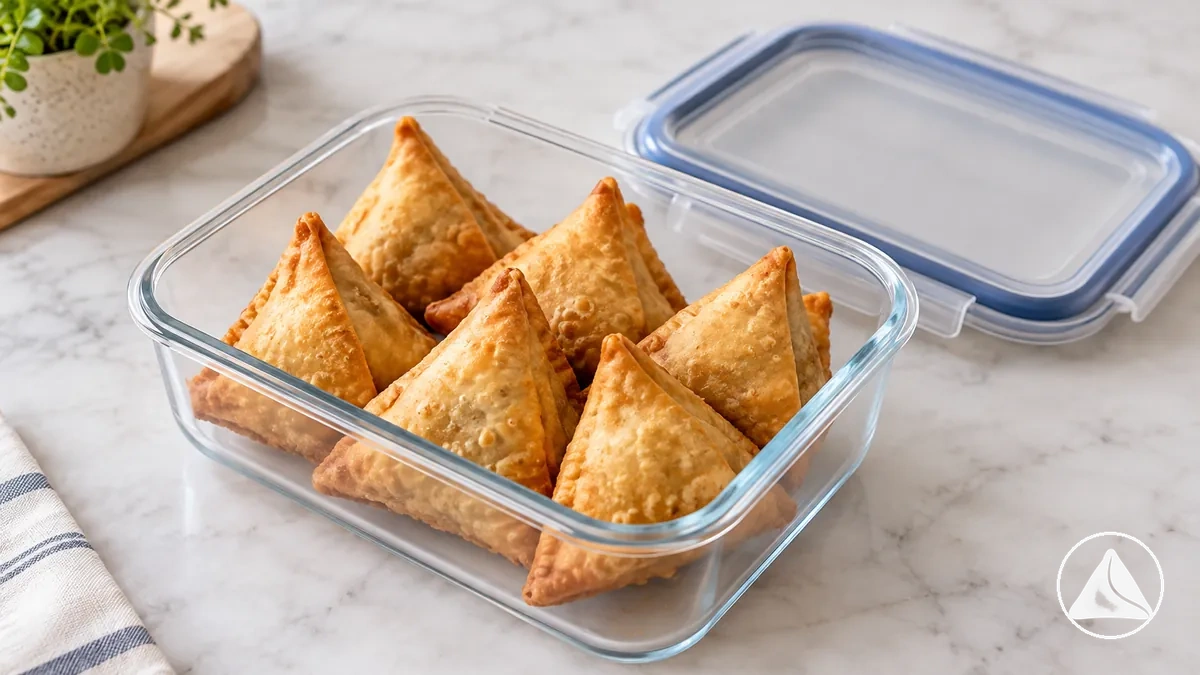
Judge the container setup by its closure, fit and the absence of trapped heat or condensation.
These criteria determine whether containment protects cooled samosas from outside exposure without retaining moisture generated inside the container.
- Closure: The lid should close securely so the airtight container remains properly sealed during storage.
- Fit: The cooled samosas should fit without being tightly compressed or preventing the container from closing correctly.
- Heat and moisture: The samosas should not be sealed while residual warmth is still producing trapped moisture or condensation; airtight storage limits outside exposure but does not remove moisture already enclosed inside.
Avoid Trapping Steam and Condensation
Residual steam from warm samosas can become trapped vapour when the samosas are sealed in a closed container.
As that vapour cools, condensation can form inside the container, returning moisture to the pastry and contributing to softened pastry during storage.
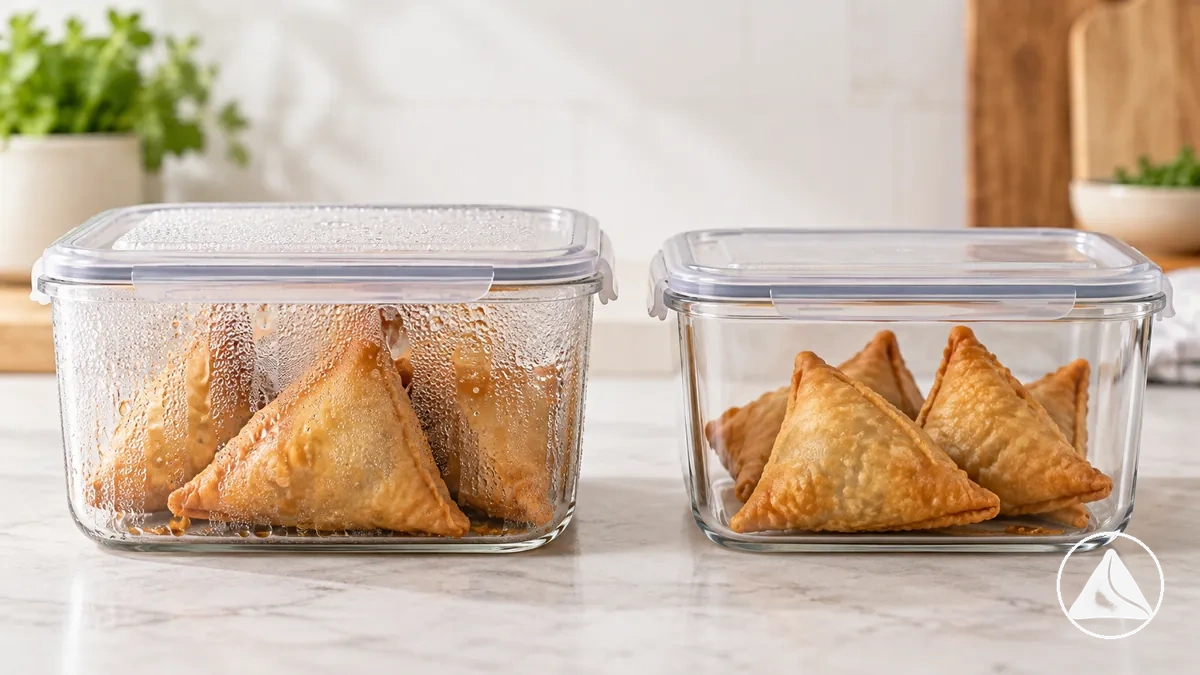
Sealed while steaming
Warm samosas release vapour into the closed container; condensation can collect on the lid and pastry, making the crust softer.
Sealed after steam subsides
More vapour escapes before the lid closes, so less moisture is trapped inside. Refrigerate promptly; do not wait for the samosas to become completely cold.
How Long Cooked Samosas Keep Under Different Storage Conditions
Cooked samosas have different storage durations depending on temperature, holding conditions and total elapsed time.
NSW Food Authority advises storing refrigerated leftovers below 5°C and eating them within 3 days; for food held between 5°C and 60°C, its 2-hour/4-hour rule uses cumulative elapsed time to determine whether food can be refrigerated, should be used immediately or must be discarded.
The image below illustrates the difference between room-temperature holding and refrigerated storage without treating texture as a food-safety measure.

The comparison below applies those Australian leftover-storage limits to cooked samosas and separates the holding window from the practical action required as elapsed time increases.
| Storage condition | Time / temperature rule | Practical implication |
|---|---|---|
| Room temperature | Less than 2 hours: use or refrigerate; 2 to under 4 hours: use immediately; 4 hours or more: discard | Count all time between 5°C and 60°C cumulatively. Once the total reaches 2 hours, the samosas should not be returned to refrigeration for later use. |
| Refrigeration | Below 5°C; eat within 3 days | Keep the samosas consistently refrigerated and use them within the advised leftover-storage period rather than extending storage duration because they still look acceptable. |
Food-safety limits and texture quality are separate attributes.
Texture can change during refrigeration without establishing whether the food is safe, while a crisp or normal-looking samosa is not proof of safety after unsuitable temperature exposure.
Food Standards Australia New Zealand states that food-poisoning microorganisms do not necessarily change a food's smell, taste or appearance.
How Long Cooked Samosas Can Stay at Room Temperature
Cooked samosas should be kept at room temperature only briefly before serving or refrigerated storage; a specific limit should follow applicable food-safety guidance rather than a universal shelf-life claim.
NSW Food Authority advises putting leftovers in refrigeration within 2 hours and applies the 2-hour/4-hour rule to cumulative time food spends between 5°C and 60°C: less than 2 hours allows use or refrigeration, 2 to under 4 hours requires immediate use, and 4 hours or more requires disposal.
The image below represents temporary room-temperature holding before that storage decision, not a visual safety test.
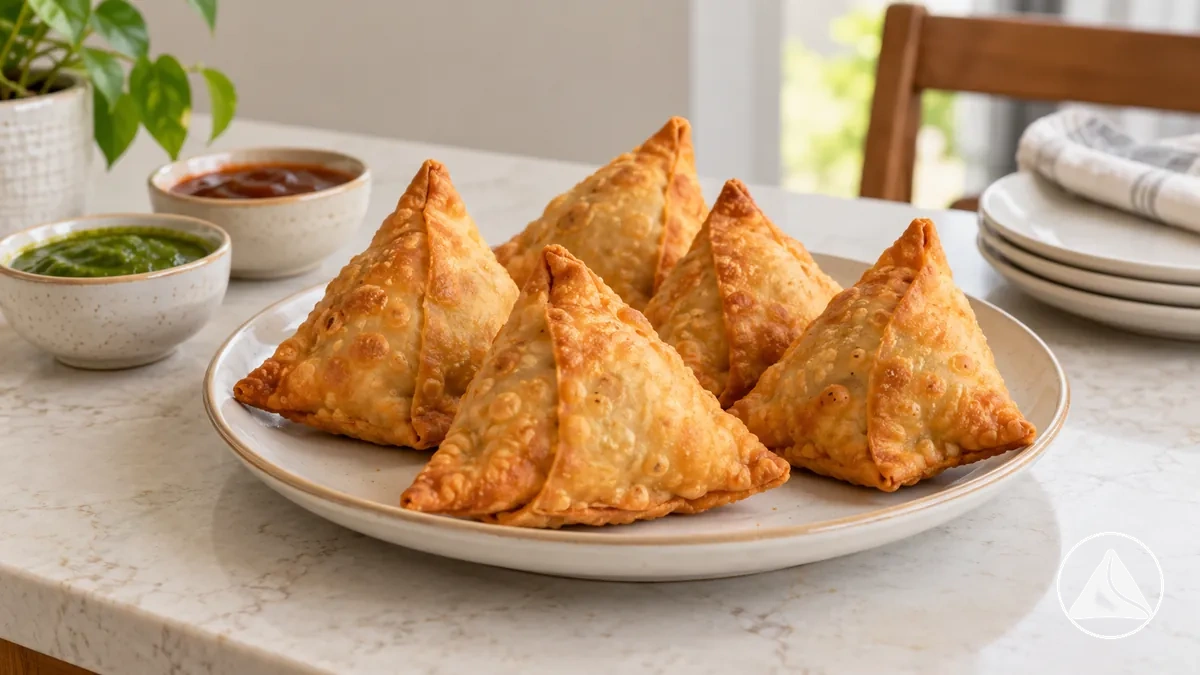
Elapsed time and ambient temperature determine the food-safety decision: brief cooling before storage should lead to prompt refrigeration, while extended room-temperature holding uses up the allowed time outside temperature control.
Food Standards Australia New Zealand states that food-poisoning microorganisms do not necessarily change a food's smell, taste or appearance, so crispness or normal appearance should not override time-and-temperature guidance.
If cumulative holding remains under 2 hours, refrigerate or use the samosas; from 2 to under 4 hours, use them immediately rather than refrigerating; at 4 hours or more, discard them.
How Long Cooked Samosas Last in the Fridge
The 3-day refrigerated-leftover limit assumes prompt cooling and continuous storage below 5°C. Before serving refrigerated samosas, check the actual storage conditions rather than relying on their appearance.
- Chilled promptly: The samosas were refrigerated during the safe cooling window, not left out beyond it.
- Kept cold: They remained below 5°C without extended periods on the bench during serving or transport.
- Used in time: They are within 3 days of preparation; a tightly closed lid does not extend that period.
- Not judged by crispness: Pastry can lose texture before the storage limit, and normal smell or appearance cannot prove safety.
If the samosas have exceeded the storage limit or their cold-storage conditions are uncertain, discard them instead of using texture as a safety test.