
Keeping Samosas Crispy After Cooking
To keep cooked samosas crispy, place them in a single, well-spaced layer on a wire rack or open tray so steam can escape; if they were fried, drain excess surface oil first. Leave them uncovered while steaming, then maintain airflow until serving—tightly covering or stacking hot samosas traps moisture and softens the pastry.
How to hold samosas at each serving stage
Match the setup to the steam coming off the pastry and the time until serving. These are ways to preserve an already-crisp shell, not to restore a soggy one.
Still steaming
Cool in the open. Spread samosas apart on a rack or open tray and let moisture escape. Avoid piling them up or enclosing them while hot.
Why: released steam can disperse rather than condense on the crust.
Brief serving delay
Hold in one layer with airflow. Keep the pastry exposed enough for residual vapour to leave; serve as soon as practical.
Trade-off: warmth slowly decreases, but less moisture is trapped against the shell.
Several hours of service
Prioritise safe temperature control. Use holding conditions suitable for the filling, with steam ventilation where possible; check texture during service.
Limit: safe warm holding and fresh-cooked crispness are separate outcomes; heat cannot guarantee both.
Need a cover? Let heavy steam subside first, then favour a loose or vented cover over a tight seal. Moisture collecting beneath a cover signals a greater risk of softening.
The starting texture depends on cooking quality, pastry composition and filling moisture; humidity and airflow then affect how quickly the crust changes. Mamta's Kitchen advises an open container for freshly fried samosas, and Switz similarly recommends an uncovered bowl or plate so steam can escape.
This guide focuses on protecting crispness after cooking, rather than frying technique, storing leftovers, reheating or fixing samosas that are already soggy.
Table of Contents
What Determines How Long Samosas Stay Crispy
How long cooked samosas stay crispy depends on interacting moisture, cooking, cooling, airflow, temperature, and holding conditions rather than a single factor.
There is no fixed number of minutes or hours that guarantees crispness: the filling, shell, humidity and holding setup change the result. Judge the crust during the hold rather than relying on a universal timer.
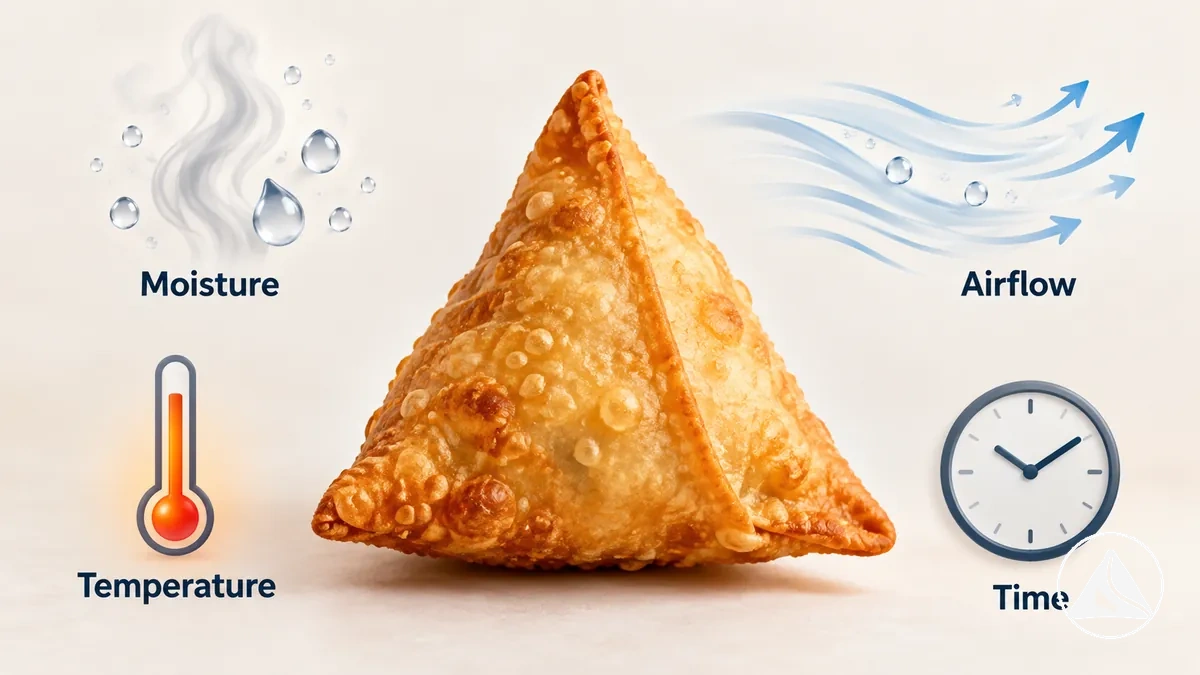
Before holding, the pastry's dryness and the moisture inside the filling establish its starting texture. After cooking, airflow, humidity and temperature influence moisture exposure; even a well-set shell may soften when hot vapour is confined.
- Pastry dryness: a drier, well-set outer pastry starts the holding period with less retained moisture, while a less thoroughly dried shell is more prone to early softening.
- Filling moisture: a wetter filling provides more internal moisture that can move towards the pastry after cooking, increasing the likelihood of softening.
- Cooking completeness: pastry that is fully set and sufficiently dehydrated begins with a firmer crisp texture than pastry that remains undercooked or moist.
- Surface oil: more oil left on the exterior can make the shell feel heavier and less dry even when the pastry has cooked through.
- Ambient humidity: more humid surrounding air increases the pastry's exposure to environmental moisture, while drier air reduces that source of moisture uptake.
- Airflow: open airflow allows heat and water vapour to move away from cooked samosas, whereas restricted airflow can keep steam and moisture concentrated around the shell.
- Temperature: very hot samosas continue releasing steam after cooking, so conditions that trap that vapour can increase condensation against the pastry as they cool.
- Holding duration: a longer delay before serving gives internal and environmental moisture more opportunity to affect the crust, making the original crisp texture progressively harder to preserve.
For example, a samosa can leave cooking with a dry, crisp shell yet soften relatively quickly if its filling releases substantial steam and it is held in humid, poorly ventilated conditions.
The same starting shell may retain crispness longer when moisture can escape and condensation is limited, but the exact duration still depends on those preparation and environmental conditions.
Moisture in the Pastry and Filling
Moisture in cooked samosas can originate inside the filling and pastry or come from the surrounding air, and each source can contribute to softening of the outer shell after cooking.
When moisture moves into a relatively dry crust, the pastry can lose crispness.
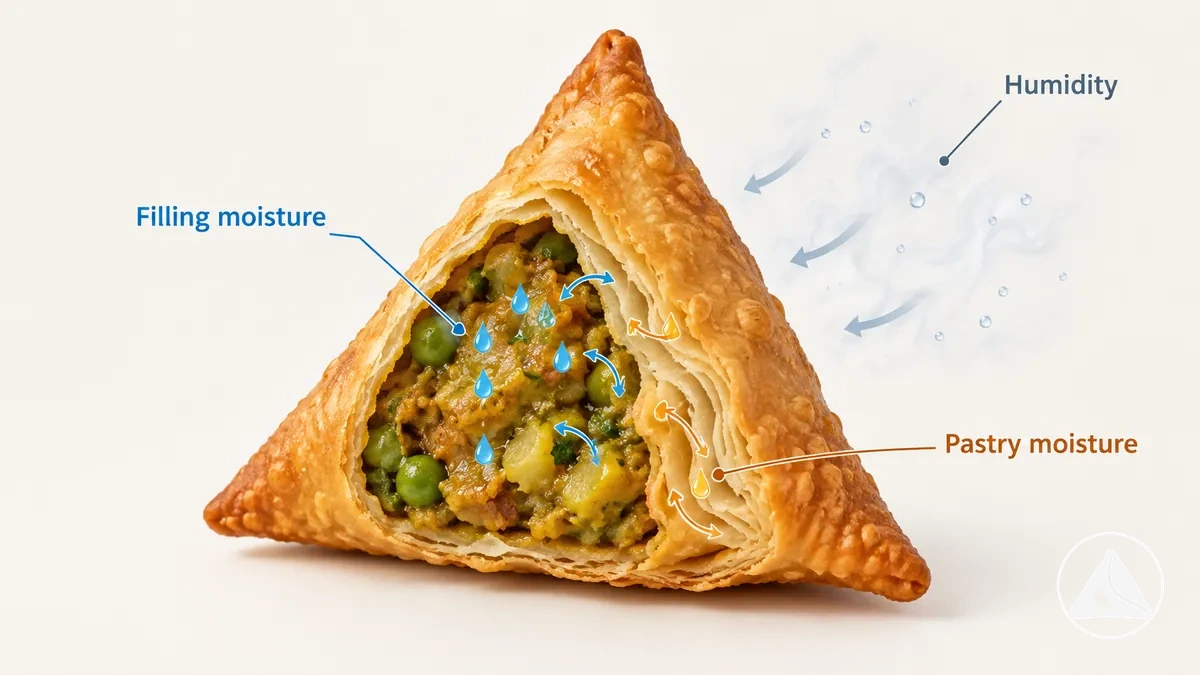
- Internal moisture: filling and pastry
- Water in the filling or cooked pastry can move towards a drier outer shell after cooking. Steam from a hot filling adds to moisture exposure when vapour is trapped. Wetter interiors raise the potential for softening, depending on how dry and well-set the shell was to begin with.
- External moisture: surrounding air
- Humidity supplies moisture from outside the samosa. More humid air increases exposure, while drier, ventilated surroundings reduce moisture build-up near the pastry. Ventilation helps steam disperse but cannot remove moisture already inside the filling.
Internal and external moisture can act together; neither source alone determines how long a samosa stays crisp.
Frying Heat and Cooking Rate
Frying heat affects the cooking rate of samosa pastry, which influences how fully the shell sets and loses moisture before cooling and holding.
Frying conditions that allow the pastry to cook through while removing sufficient moisture give the shell a firmer starting texture for post-cooking crispness.
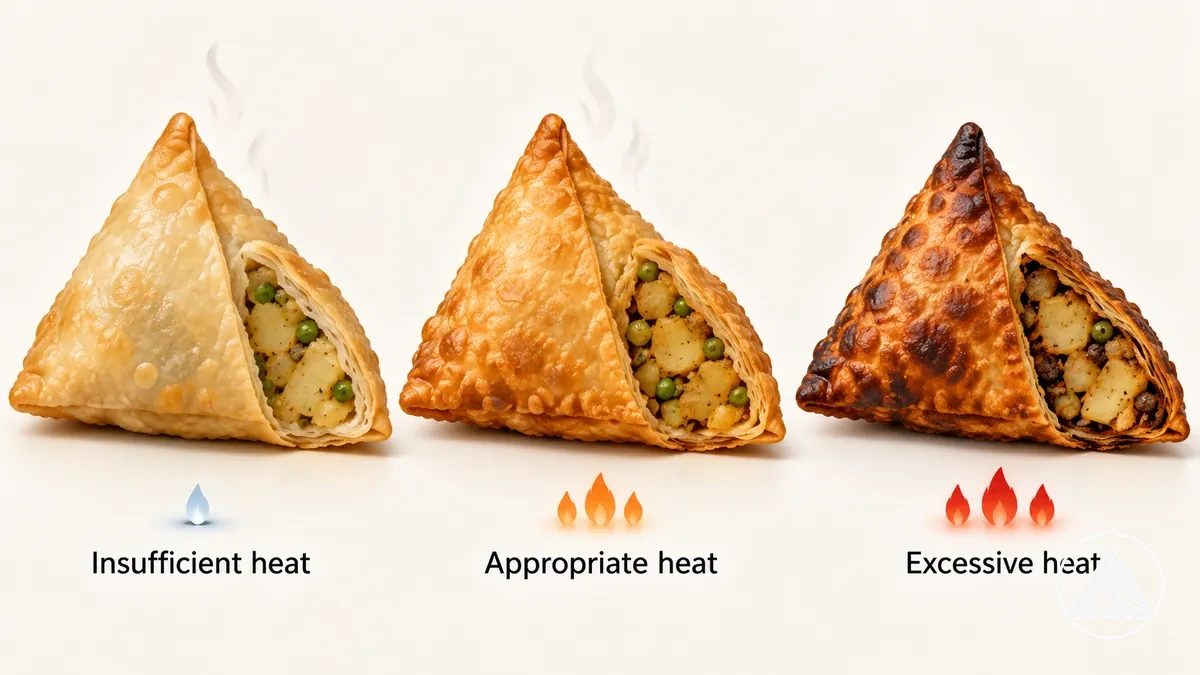
- Insufficient heat
- Cooking takes longer; the pastry can remain pale while moisture leaves slowly. A shell that finishes too moist is more vulnerable to softening.
- Appropriate heat
- The pastry has time to cook through and release moisture, supporting a firm, crisp shell at the start of cooling.
- Excessive heat
- The outside may brown and set before the inside is cooked. Dark colour does not prove that the samosa has cooked evenly.
Oklahoma Cooperative Extension Service similarly reports that lower frying temperatures lengthen cooking time, while high-temperature frying can cause the crust to cook faster than the interior.
Frying heat therefore influences moisture removal, surface colour, and the texture of the pastry when cooking ends.
A well-set shell may begin the holding period with better crispness, but later texture still depends on filling moisture, cooling, airflow, and other post-cooking conditions.
If the outside browns before the interior is properly cooked, adjust the frying heat and cooking rate at the cooking stage; cooling cannot correct an undercooked shell. Here the relevant outcome is the pastry condition that cooling and holding must maintain.
Cool Samosas Without Trapping Steam
Freshly cooked samosas should cool in an open, ventilated place where steam can escape instead of condensing against the pastry.
The goal is to reduce moisture contact with the shell while the samosas move from cooking temperature toward short-term holding.
Spacing and airflow help released steam move away from each samosa, while draining excess oil where relevant keeps the surface from remaining unnecessarily coated.
Because cooling rate changes with samosa size, filling temperature, room conditions, and cooking method, readiness is better judged by the amount of escaping steam than by a fixed number of minutes.
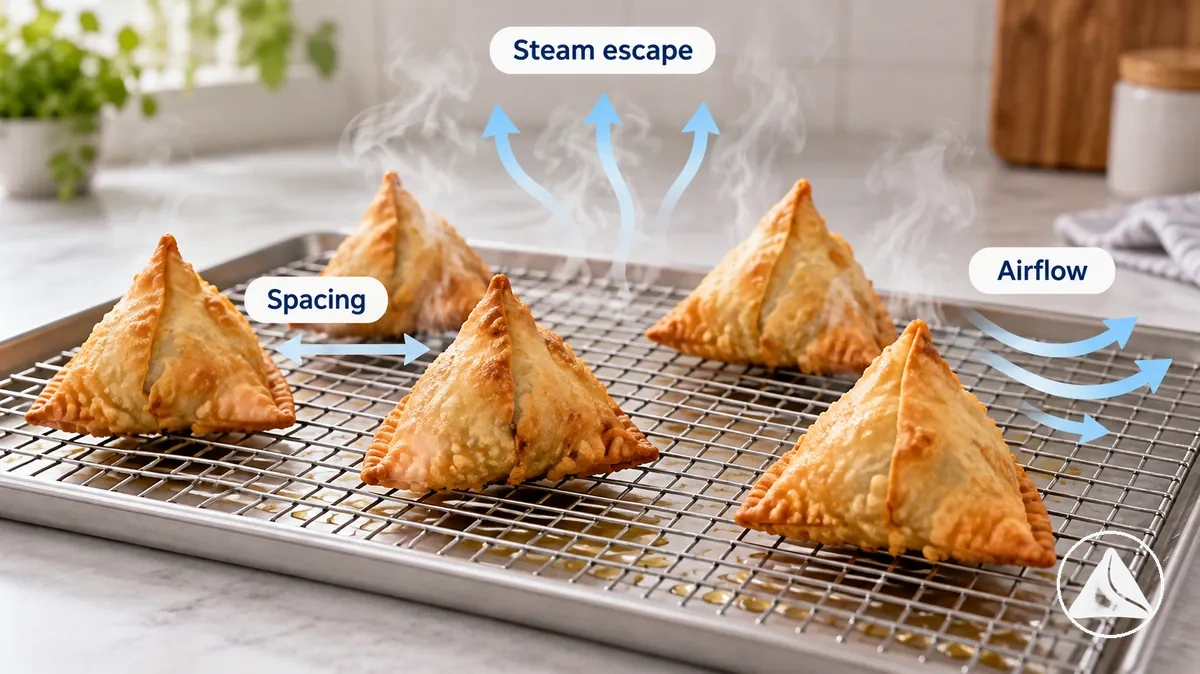
- Remove the samosas from the cooking environment. Transfer them away from hot oil, a baking tray, or another actively heated surface so residual heat is not continually added during cooling.
- Drain excess oil where relevant. Allow fried samosas to shed loose surface oil so the pastry is not left sitting in a pool or heavy coating while steam is escaping.
- Space the samosas apart. Keep the pieces separated rather than touching or stacking so steam from one samosa is less likely to collect against another.
- Maintain airflow around the pastry. Use an open, ventilated setting that lets warm vapour disperse instead of enclosing the samosas while they are still releasing substantial steam.
- Assess readiness for short-term holding. Move the samosas to the next holding stage once visible or concentrated steam has largely dissipated and the pastry is no longer being exposed to trapped hot moisture.
Move to short-term holding when heavy steam has largely dispersed and it is less likely to condense against the pastry. Larger samosas, hotter fillings and less ventilation can extend cooling, so use escaping steam as the guide rather than a fixed minute count.
Crowding, stacking very hot samosas, or enclosing them too early can concentrate steam around the shell and increase the chance of softening.
Open, spaced cooling gives that moisture a clearer route away from the pastry before holding begins.
If the pastry is already noticeably soft rather than simply releasing steam during normal cooling, that becomes a separate sogginess-diagnosis problem rather than a cooling-sequence issue.
Hold Samosas Crisp Until Serving
After initial cooling, preserving crispness is a balance of holding time, airflow, moisture exposure and desired serving warmth.
A brief serving delay is easier to manage than a long one because more time gives steam and surrounding moisture more opportunity to affect the pastry.
Ventilation lets moisture escape, while high humidity, tight covering, and stacking can keep moisture close to the shell.
Samosa Shack advises holding warm samosas in a single layer with ventilation rather than covering or stacking them, because trapped steam can soften the pastry.
Heat exposure can preserve warmth, but it does not remove the need for airflow, so the holding conditions must balance temperature with moisture escape.
The illustration highlights the main conditions that influence crispness during the holding period.
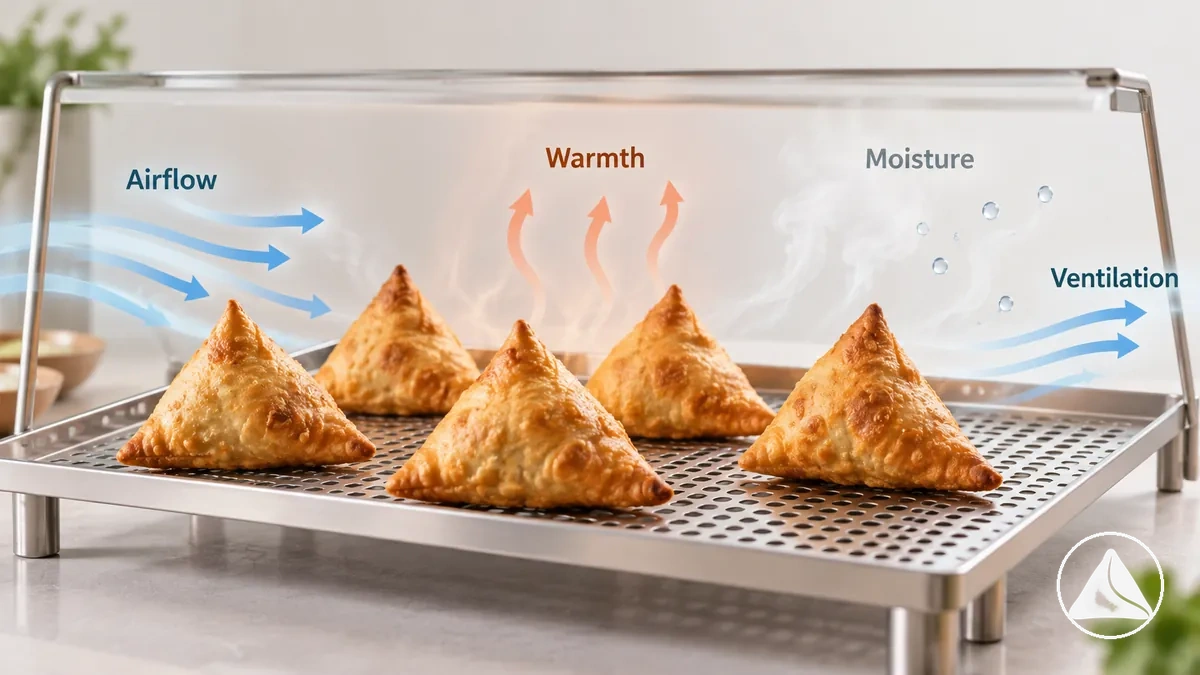
- Holding time: a shorter delay gives moisture less time to affect the crust, while a longer delay increases the opportunity for crispness to decline.
- Airflow: open airflow carries warm vapour away from the samosas, whereas restricted airflow leaves more moisture around the pastry.
- Humidity: humid surrounding air increases external moisture exposure, while drier conditions reduce that source of moisture uptake.
- Ventilation: a vented holding environment gives steam a route out instead of allowing it to accumulate around the shell.
- Stacking and covering: stacking warm samosas or enclosing them tightly can concentrate steam between surfaces and increase the likelihood of softening.
- Heat exposure: added warmth can help maintain serving temperature, but without adequate ventilation it can also leave released steam close to the pastry.
For a short serving delay, spacing and ventilation can remain the main priorities while the samosas retain residual warmth.
For longer service, warmth and crispness become competing goals: there is no single holding duration or setup that preserves the original texture in every environment. Where the filling requires temperature control, apply the relevant food-safety holding rules as well as managing condensation.
Long-term storage and later reheating are separate tasks from holding samosas for service.
This stage ends when the goal changes from maintaining serving texture to storing the samosas for a later occasion.
Keeping Samosas Crisp for a Short Hold
When cooked samosas have cooled enough for serving but service is delayed briefly, the goal of a short hold is to preserve the crispness already present in the pastry rather than restore lost texture.
Keep the samosas exposed enough for residual steam to escape so the brief serving delay does not promote moisture accumulation around the crust.
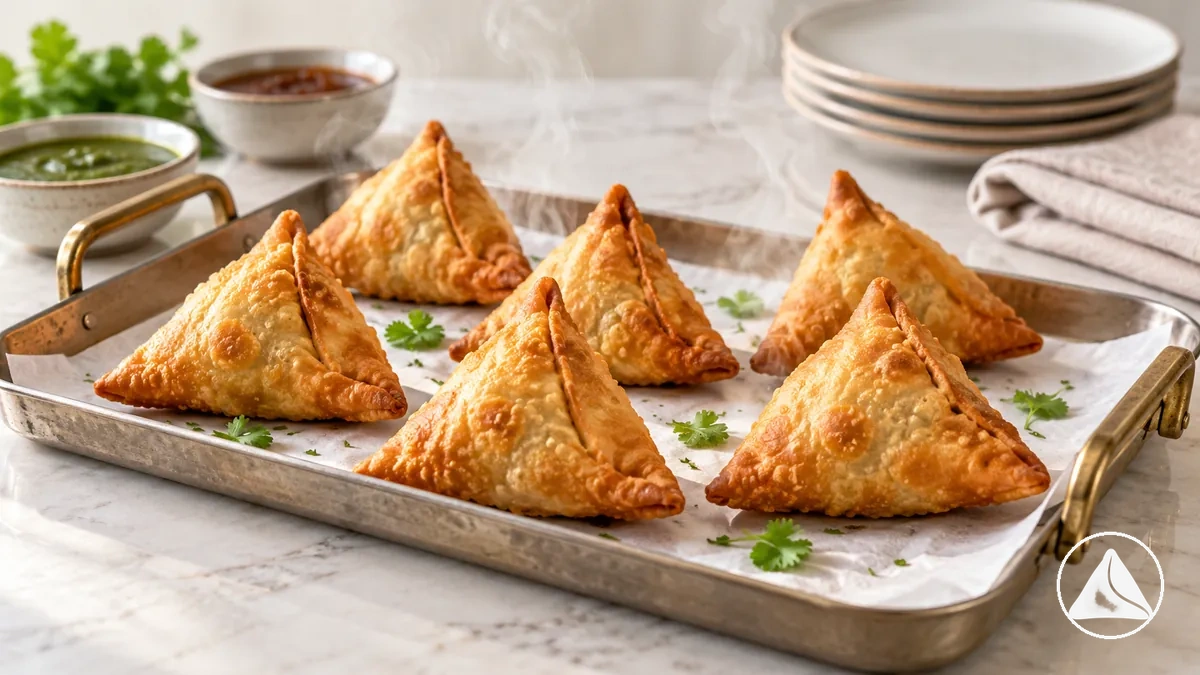
Maintain spacing between the samosas and enough airflow around the pastry to let remaining steam disperse instead of collecting between pieces.
In humid room conditions, unnecessary covering can increase moisture exposure by retaining vapour near the crust; Mamta's Kitchen similarly advises keeping freshly fried samosas in an open container so steam does not condense on them.
If warmth still matters, avoid arrangements that trap steam simply to retain more heat, because the short hold is intended to maintain serving texture rather than maximise warmth.
A short hold is a serving-stage condition, not long-term storage or a reheating method.
Keeping Samosas Crisp and Warm for Several Hours
A multi-hour hold means balancing serving warmth with pastry crispness. These goals do not have a single setting that guarantees both outcomes.
- Retaining warmth
- Heat can maintain serving temperature, but enclosed or poorly ventilated heat also allows steam to collect. The appropriate heat setting depends on the food-safety needs of the filling and the holding equipment.
- Retaining crispness
- Spacing and airflow move vapour away from the crust. High ambient humidity works against this, while prolonged dry heat can over-dry the pastry. Texture needs checking as the hold continues.
The practical setup depends on the filling, ventilation, humidity, holding equipment and length of service; even under suitable conditions, texture can change from its freshly cooked state.
Once service ends and the samosas need warming again later, the task changes to storage and reheating, not continued crisp holding.
Covering Samosas Without Trapping Condensation
Covering cooked samosas can protect them from surrounding exposure, but it can also trap water vapour and promote condensation against the pastry.
The effect on crispness depends mainly on samosa temperature, ventilation, cover tightness, and holding duration rather than on covering being universally helpful or harmful.
- Tight cover while very hot
- Hot samosas continue releasing steam; little ventilation leaves that vapour near the shell. Condensation becomes more likely, especially when the lid stays on for longer or visible droplets collect.
- Loose or vented cover after steam subsides
- Moist air has a way to escape, reducing build-up relative to a tight seal. This lowers the risk but cannot guarantee crispness; check for moisture collecting under the cover.
Oklahoma State University explains that excess water vapour can condense into liquid on surfaces, while Samosa Shack specifically notes that closed boxes and foil coverings trap steam around samosas and can soften the pastry.
Whether covering is helpful depends on samosa temperature, ambient humidity, ventilation, cover tightness and how long it stays in place. If droplets form beneath the cover, allow more steam to escape.